
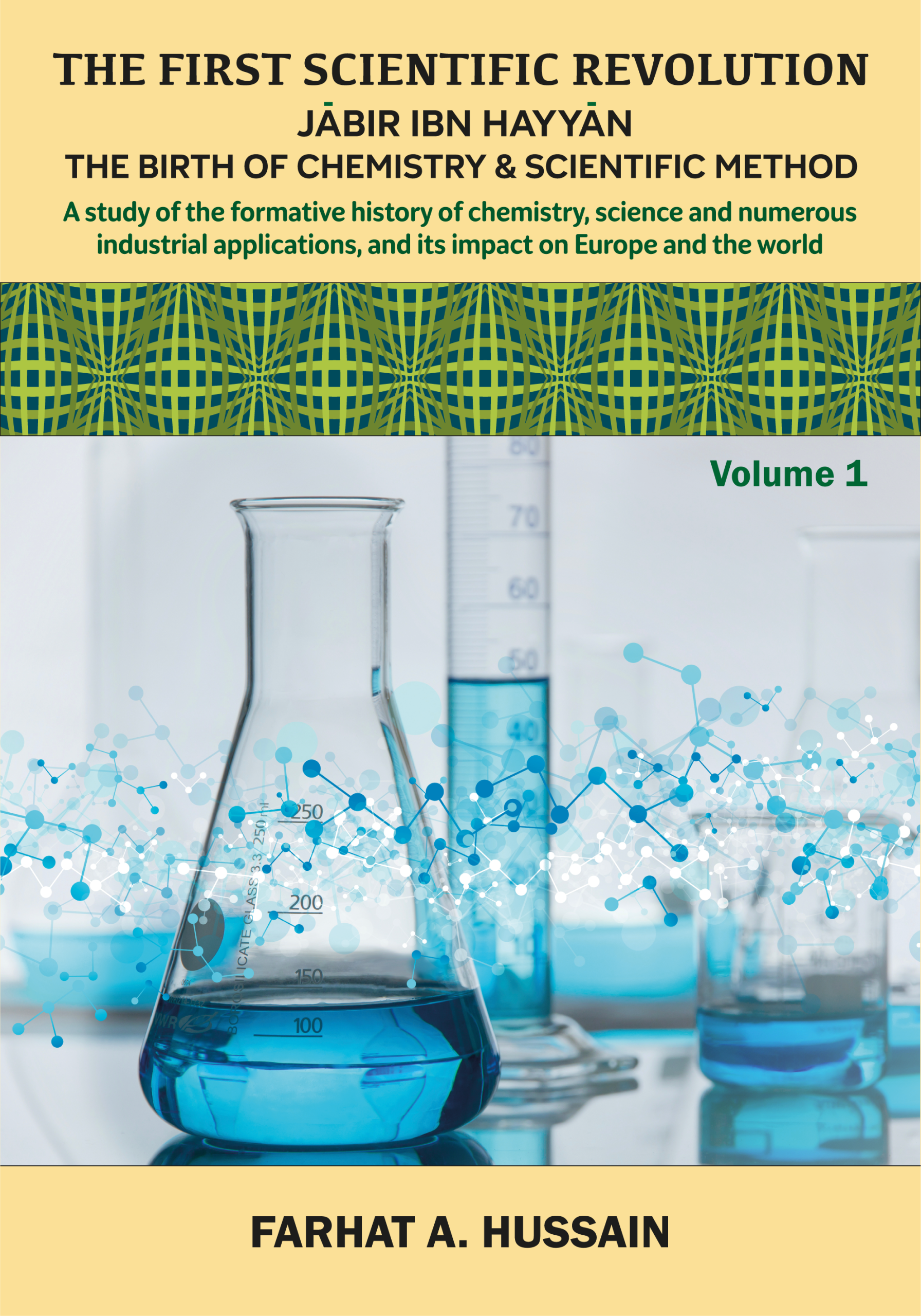
The First Scientific Revolution
Jābir bin Hayyān: The Birth of Chemistry & Scientific Method. Volume 1 (of 2)
A study of the formative history of chemistry, science and numerous industrial applications, and its impact on Europe and the world
Author: Farhat A. Hussain
Portrait: 240 mm height x 168 mm width
200,000+ words excluding preface, bibliography, appendix and index
Pagination: 740, including front matter, bibliography and index
Hardback: ISBN 978-1-0686653-0-1
Well-referenced throughout
Supported with unique colour maps and a range of polychrome and monochrome illustrations
Volume 2 is due to be published in a few months time
Publication date: July 2026
Notice: This book is of considerable weight
Book size change from 240 mm height x 170 mm width to 168 mm width
Add price below all existing information about the book:
UK: £59.99; Eurozone (EUR): €79.99
Details of worldwide prices, institutional rate and other formats to follow.
A comprehensive study of the life, work and impact of Jābir ibn Hayyān (721-c. 815/816 CE/AD), chemist and scientist, whose influence in chemistry, science, industry, culture and civilization in his own time and for subsequent history, across much of the world, cannot be overstated. Interwoven with and set against a substantial historical background of his times and challenges, volume 1 of this 2-volume series comprises a substantial study of this fascinating subject. Commencing with a study of chemistry in prehistory and thence many civilizations of the ancient world, this highly analytical work thereafter outlines the scope of chemistry in the early medieval period. How this scope, depth and application of chemistry was greatly advanced by Jābir ibn Hayyān, in reflection of his high abilities and dedication, yet also the direction of his teacher, Imām Ja’far al-Sādiq (702-765 CE/AD), is demonstrated. The presence of mythology and superstition, as well as limitations of the ancient and early medieval periods, were supplanted as a truly scientific chemistry emerged. Scientific method was applied for the first time to such a scale and scope, constituting, the author argues, the first Scientific Revolution, many centuries before that undertaken in Europe, and in many ways influencing the latter. The important work of European chemists and scientists is also acknowledged and celebrated. A substantial number of studies by Jābir ibn Hayyān are cited and explored, as he introduced or greatly advanced key chemistry processes, discovered nitric acid, sulphuric acid and hydrochloric acid, introduced scientific writing of this scope and standard, including the scientific report, wrote of atomic theory and particle physics, emphasised the balance, engaged in quantitative method and analysis and many other vital aspects of chemistry and science in use today. Jābir ibn Hayyān applied this vast body of work in various fields, as alluded to in this volume and discussed in volume 2. The book demonstrates Jābir ibn Hayyān’s originality, dedication, skills, high standards, and professionalism, as well as his impact on chemistry, science, culture, civilisation, industry, the economy, and human progress. The role of chemistry in advancing science over one thousand years ago is also highlighted. Authored by a qualified and able archaeologist, historian of civilization, including science, sociologist and educationalist, contributing to knowledge and understanding, this well-referenced and well-illustrated several-hundred-page book takes the reader on a fascinating odyssey through a most formative period in the history of chemistry, science, industry and civilization. Written for those who study, teach and work in chemistry, science, industry and history, including the history of science, and members of the wider public.
Contents
Preface
List of illustrations
List of tables/charts
List of maps
List of abbreviations
Acknowledgements
Part 1. Introduction
Part 2. Prehistory and the Ancient World
Part 3. The Early Medieval World
Part 4. Islām, Science and Chemistry
Part 5. Jābir ibn Hayyān: Life, Studies and Research
Part 6. Overview of Work in Chemistry and Science
Endnote