
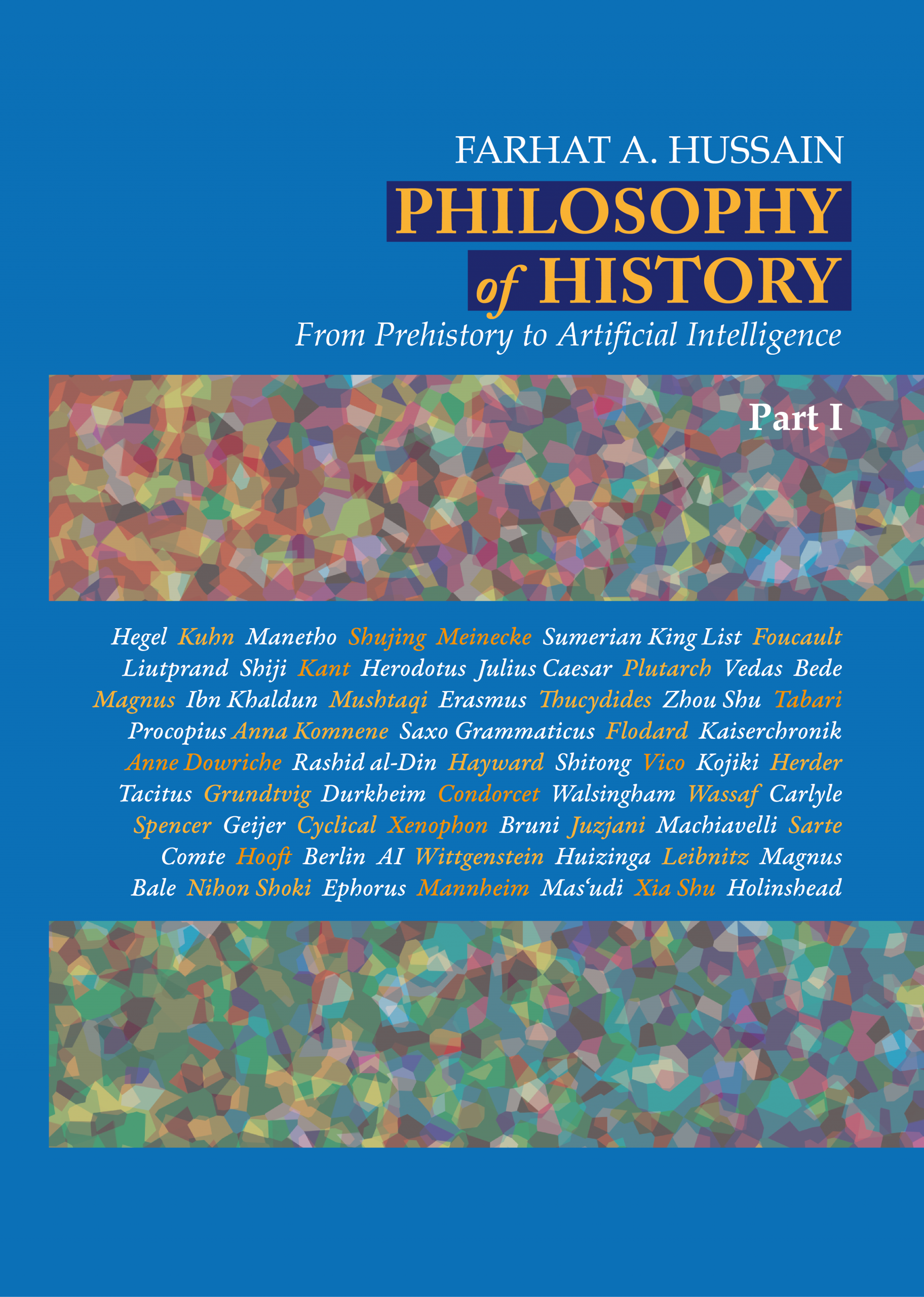
Philosophy of History: From Prehistory to Artificial Intelligence
Part I
Author: Farhat A. Hussain
Portrait: 246 mm height x 175 mm width
pp. 872 of which 72 are in full colour.
Hardback: 978-1-0686653-5-6
UK: £64.99; Eurozone (EUR): €85.
Details of worldwide prices, institutional rate, other formats and publication date to follow.
Also referred to as ‘The Blue Book’, this two-part pioneering and thought-provoking foundational work of considerable scale, scope and depth explores a substantive range of contributions in the field of philosophy of history and historical thought from prehistory to the present-day. Drawing on a vast range of archaeological and historical evidence and evaluating a huge body of primary sources and scholarship, the unique scope of this interdisciplinary and cross-disciplinary work allows for an exploration of the minds, work and thought of historians and thinkers from diverse periods, places and contexts. The influences on and impact of their work across time and space are also examined in this well-referenced study. This work addresses key threads across time and space in addition to that which was unique to place, persons and period. Critiquing isolationist approaches to history in composition and impact, this work explores the limitations of various approaches to history in the past and their impact on the discipline and its implications today. This significant critique and the framework of the author of cosmopolitan history (CoH) provides a diverse readership across society and the world with a vital means to connect with notable, yet underrepresented aspects of the story of the human race, the history of knowledge and ideas and the history of civilization.
Vital questions concerning what history comprises and the aims, scope and impact of historical studies, insight into truth and reliability and the dynamics of history are considered. Whether in the ancient, medieval, early modern or modern periods, the approaches by historians from many different cultures and civilizations and periods provide the reader with the means to consider the relationship of philosophy of history and/or historical thought and the content of historical studies across time and space, enrich historical knowledge and understanding and generate unique comparative study, insight and perspectives. Therefore, this work offers the reader a unique exploration of historical understandings, often set against the backdrop of historical developments and phenomena spanning a vast scope of human experience and existence. A unique synthesis, various fields are examined and contributed to, and new avenues of inquiry are identified and addressed. This work and series draw on the engagement of many key issues by the author over many years and his large-scale university education of many themes, periods and phenomena in archaeology, history and related fields and the study of knowledge. The author’s interest in the historic and contemporary interaction of cultures and civilisations is evident throughout this work, serving to highlight and critically examine particular issues in the philosophy and historical works of the writers addressed.
Comprising a complete study in its own right, Philosophy of History is divided into 2 parts or volumes. These books provide vital foundations as volumes 1 and 2 of this 10-volume series by the author. A key focus of this pioneering series is the nuance, dynamism and synergies evident in the story of the human race and their relevance to the advancement of culture and civilization, with a lasting impact on the present-day and relevance to the future. In Part 1 foundational discussion includes a critical study of intellectual history and the sociology of knowledge (including Artificial Intelligence), followed by a considerable examination of the prehistoric, ancient, medieval, Renaissance Europe and the European Enlightenment periods. Exploration and, therefore, acknowledgement are also provided of early human experience, understanding, and utility of history in the prehistoric period, which is often absent in studies of history and, more so, in thought related to history and related issues, in capturing a foundational period of human presence, activity, and thought. The work of a substantive number of European historians and thinkers is evaluated, including concerning Eurocentrism. Where evident, interest in other cultures and civilizations or the absence of this issue is evaluated and analysed, as are gaps in methodology and content and their implications for knowledge, society and much else. Many historians from non-European lands, including China, Japan, India, Egypt, Mesopotamia and other ancient civilizations and cultures and the Muslim world, are also addressed in this volume. Extending impetus in preceding parts of this book, the aims, scope and depth of the cosmopolitan history of Kant and the world and universal history of Hegel are critically contrasted to the highly applicable cosmopolitan history approach and framework of the author, which is addressed in Part 2 as a body of knowledge.
Of value to readers, educational institutions, organisations in the private and state sectors, society and the wider world in the twenty-first century, this work comprises a considerable contribution to knowledge and understanding at a variety of scales and contexts of the past and present. This two-part publication explores a fascinating yet relatively neglected aspect of history and historical studies imaginatively and powerfully. Valuable insights into a substantive number of persons, places, subtle, substantive and often interlinked phenomena, developments, approaches and thought are provided. Commonality and uniqueness in history are demonstrated via an overview and in-depth examination of historians and issues explored and analysed across human history. The role of the translation of culture, especially the modifications in meaning and form of words, knowledge, ideas, material culture and phenomena, is celebrated as a notable facet of the human story. The potential, relevance and challenges of Artificial Intelligence are explored and discussed. Identifying and celebrating past synergies, this study contributes to establishing, developing and strengthening those of the present and future in a vast range of fields, contexts and scales. Addressing the twenty-first century, this significant scholarship contributes to valuable cross-fertilisation of knowledge, understanding, time, place, people, organisations, bodies, states and phenomena. Reflective of its scope, method, content and utility, this work is much anticipated by academics, students, professionals, members of the broader public across society and the world. Speaking to various prominent and subtle issues relevant to the complexity of the twenty-first century, this two-part study and ten volume series takes the reader on a unique odyssey of knowledge and understanding and forges considerable fraternity with the human race and its dynamic story.
CONTENTS
Preface
Contents
List of illustrations
Acknowledgements
List of abbreviations
1. Introduction
Introduction
What is history?
Intellectual history
Introduction
Historical background
Women
External influences on European intellectual history
Quentin Skinner
Ludwig Wittgenstein
Michel Foucault
Friedrich Meinecke
Johann Herder
Quentin Skinner (continued)
Isaiah Berlin
Hermeneutics
The intellectual history of historiography
Cosmopolitan history
Surmise
An introduction to the field of the philosophy of history
Sociology of knowledge
Introduction
Emile Durkheim
Max Scheler
Karl Mannheim
Robert K. Merton
Peter L. Berger and Thomas Luckmannn
Michel Foucault
Further analysis
Introduction
Social context of the past
The sociology of knowledge of historians
The Higher Education sector, with special reference to historians
Technology (Pre-AI)
Public space
Publications
Social media
Podcasts
Artificial Intelligence (AI)
Other issues
Surmise
Footnotes
Epilogue
References
Author biographical sketch
2. Prehistory
Introduction
Earliest writing
Storytelling
Place
Monuments and time
Movement as a social process
Safety via historical perspective
Folklore
Oral tradition
Petroglyphs
Mother-deities
Monotheism
Cave and wall paintings
Memory
The mind
Identity
Social anthropology
Epilogue
References
Author biographical sketch
3. The Ancient World
Introduction
Egypt
Hieroglyphs
King Lists/Royal Annals
Manetho
Mesopotamia: The Sumerian King List
India
China
Shujing/Shu-King (Book of Documents/Classics of History)
Xia Shu (Book of Xia)
Zhou Shu (Book of Zhou)
Shiji (Records of the Grand Historian)
Greece
Introduction
Herodotus
Thucydides
Xenophon
Ephorus
Endnote
Rome
Overview of approaches by Roman historians
Julius Caesar
Lucius Plutarch
Publius/Gaius Tacitus
Epilogue
References
Author biographical sketch
4. The Medieval World
Introduction
Religion and the philosophy of history
Christianity
Introduction
The Old Testament
The New Testament
Christian historians and historical works
Introduction
Byzantine Empire
Introduction
Annianus of Alexandria
Procopius of Caesarea
Anna Komnene
George Akropolites
England
Introduction
Bede
The [Saxon] Chronicle
The Norman Conquest
The Bayeux Tapestry
Norman Chroniclers
William of Malmesbury
Ireland
Chronicle of Ireland
Denmark
Introduction
Saxo Grammaticus
Sven Aggesen
Chronicon Roskildense
France
Introduction
Flodoard of Reims
Aimoin of Fleury
Jean de Joinville
Italy
Introduction
Paul the Deacon
Liutprand of Cremona
Giovanni Villani
German states
Introduction
Adam of Bremen
Otto of Freising
The Kaiserchronik
Islām
Introduction
The Qur’ān
Hadīth
Historians of the Muslim world
Introduction
Al-Tabarī
Al-Mas‘ūdī
Rashīd al-Dīn
Ibn Khaldūn
The Delhi Sultanate
Introduction
The Mamlūk dynasty
Overview
Jūzjānī
The Khilji dynasty
Overview
Wassaf
Other historians
The Tughluq dynasty
Overview
Amīr Khusrow
Ibn Battuta
Zia ud-Dīn Baranī
The Sayyid dynasty
Overview
Yahyā bin Ahmad Sirhindi
The Lōdhī dynasty
Overview
Mushtāqī
‘Abbas Khan Sarwani
Other historians of the Lōdī dynasty
Further analysis
Kalhana of Kashmir
China
Introduction
Shitong
Zizhi Tongjian
Japan
Kojiki
Nihon Shoki
Defeat of the Mongol invasions
Scandinavia in the Viking Age
Epilogue
References
Author biographical sketch
5. Renaissance Europe
Introduction
Renaissance thought
Leonardo Bruni (Italy)
Niccolò Machiavelli (Italy)
Desiderius Erasmus (Netherlands)
Pieter Hooft (Netherlands)
Olaus Magnus (Sweden)
Arild Huitfeldt (Denmark)
England
Introduction
The fifteenth century
John Capgrave and John Flete
Thomas Rudborne, Thomas Elmham
and Thomas Walsingham
The sixteenth century
John Bale
Alexander Neville
John Hayward
Anne Dowriche
Raphael Holinshed
Further discussion
Further analysis
Epilogue
References
Author biographical sketch
6. The Enlightenment
Introduction
Giambattista Vico
Marie-Jean-Antoine-Nicolas de Caritat, Marquis de Condorcet
Immanuel Kant
Johann Gottfried von Herder
Georg Wilhelm Friedrich Hegel
Epilogue
References
Author biographical sketch